
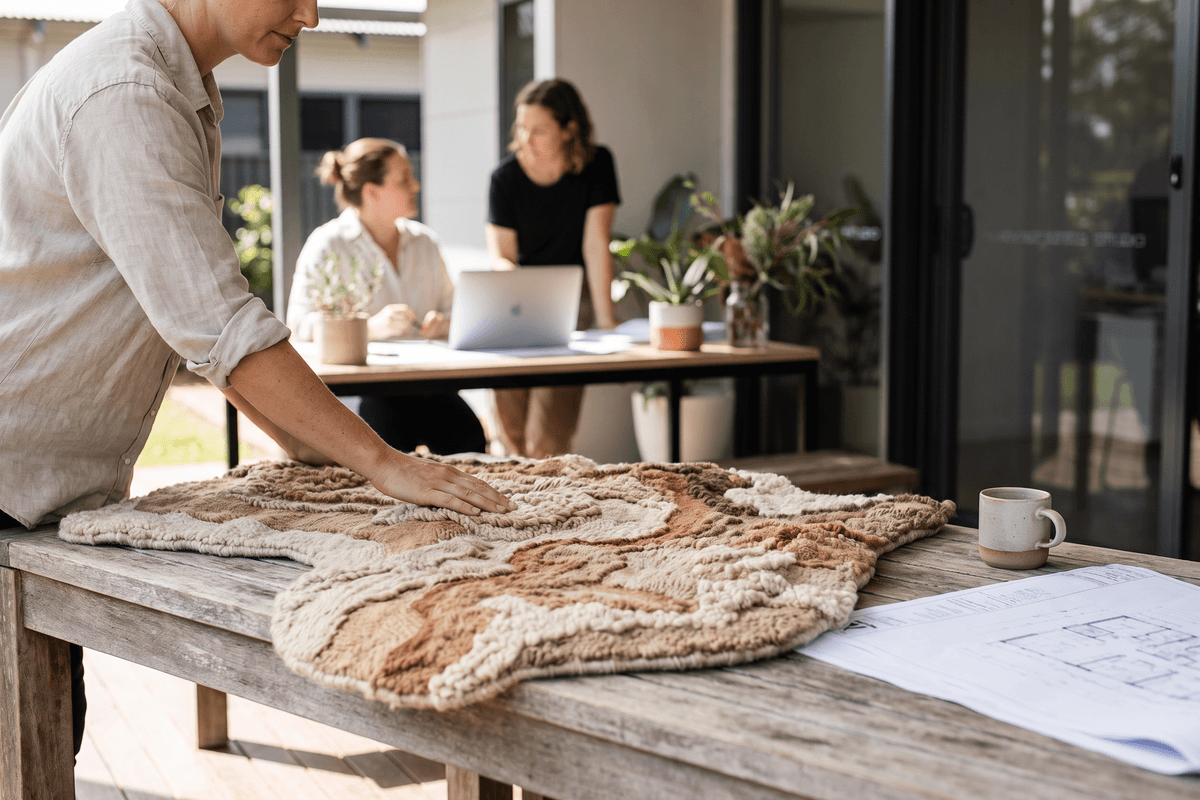



In an era dominated by generative neural networks, high-polygon digital twins, and hyper-polished parametric simulations, the most striking architectural landscape model produced in Australia this year was made with yarn and a hook. When a Charles Darwin University (CDU) architectural design student took top honours in the Northern Territory leg of the 2026 SuperStudio competition by presenting a freehand crocheted topographic model, the victory was more than a charming creative departure. It was an explicit critique of computational homogenisation and an urgent reminder of what tactile craft can teach spatial practitioners about landscape, permeability, and ecological empathy.
Organised annually by the Student Organised Network for Architecture (SONA) and the Australian Institute of Architects, SuperStudio is renowned for its intense, rapid-fire design briefs that push students to conceptualise complex civic and environmental solutions under strict time constraints. While peer submissions predictably leaned into CAD workflows, photorealistic renders, and parametric meshes, the winning Northern Territory entry demonstrated that material intelligence often speaks louder than algorithmically generated geometry.
The Parametric Fatigue and the Return to Material Logic
For over two decades, architectural representation has chased absolute fidelity through the digital screen. Yet, as practices across Australia navigate increasingly complex environmental and community mandates, a growing sense of "rendering fatigue" has emerged among practitioners, juries, and the public alike. Digital models, while indispensable for documentation and precision engineering, often impose a rectilinear stiffness or an algorithmic detachment that flattens the nuanced realities of physical terrain.
By deploying freehand crochet, the CDU student tapped into an ancient mathematical and structural logic. In structural engineering and mathematics, hyperbolic geometry—which nature frequently employs in coral reefs, kelp forests, and undulating landscapes—is notoriously difficult to model digitally without complex scripting, yet it emerges naturally through the continuous tension of crocheted stitches.
"Tactile modeling forces a designer to negotiate material tension, structural gravity, and porosity in real-time. When modeling a landscape through fiber, you aren't just drawing a contour line; you are weaving a porous, adaptive surface that mimics the organic behavior of topsoil, root systems, and water retention."
This approach transforms the landscape model from a static, frozen object into an active, structural prototype. The soft transitions, variable densities, and tactile porosity inherent in the crocheted surface mirrored the ecological requirements of Top End water management, soil erosion control, and microclimatic cooling far more intuitively than a rigid 3D-printed resin block ever could.
Regional Pedagogy: The Northern Territory’s Unique Spatial Canvas
The fact that this design breakthrough emerged from Darwin is far from coincidental. Northern Territory architecture has long cultivated an innate skepticism toward imported, southern-centric architectural dogmas. In the extreme wet-dry tropics of the Top End, buildings and landscapes cannot rely on sealed envelopes or purely mechanical systems; they must breathe, expand, filter, and adapt.
At Charles Darwin University, architectural education is increasingly anchored in deep environmental responsiveness and local material traditions. Tropical architecture requires an understanding of edge conditions—verandahs, permeable screens, deep eaves, and ground planes that absorb monsoonal deluges without sacrificing structural integrity.
Crochet, as a spatial modeling medium, embodies these exact architectural properties:
- Variable Permeability: Stitches can be tightened or loosened to represent different soil absorption rates or wind-filtering vegetation canopies.
- Tensile Integrity: The continuous yarn structure demonstrates how decentralized, interconnected systems distribute physical stresses across an undulating terrain.
- Tactile Inclusivity: Physical fiber models allow clients, Indigenous stakeholders, and non-architects to physically touch and intuitively understand complex spatial topographies without deciphering abstract architectural notation.
Comparing Conceptual Modeling Modalities
To understand the pedagogical and professional value of this approach, it is worth examining how different modeling media communicate spatial ideas during early design phases:
| Modeling Medium | Primary Strengths | Representational Blind Spots | Strategic Application |
|---|---|---|---|
| Digital BIM / NURBS Meshes | High dimensional precision, rapid iteration, seamless translation to contract documentation. | Lacks material resistance; creates false sense of finished certainty early in design. | Technical documentation, spatial coordination, construction sequencing. |
| 3D Printing / CNC Milling | Exact geometric translation, fast production of solid volumetric masses. | Rigid, non-porous materiality; high plastic/resin waste; visually sterile. | Urban massing studies, precinct masterplanning, precision structural nodes. |
| Tactile Fiber / Freehand Craft | Intuitive hyperbolic geometry, organic porosity, sensory engagement, low embodied carbon. | Lacks millimetric dimensional accuracy; challenging to scale directly into standard fabrication. | Early concept development, ecological/landscape modeling, community co-design workshops. |
The National Conversation: Resilient Spatial Design in October 2026
This grassroots victory in Darwin aligns seamlessly with the major themes sweeping through the national profession this season. As highlighted in ArchitectureAu’s October 2026 industry preview, the Australian design calendar is dominated by discussions surrounding climate resilience, circular material economies, and the re-evaluation of design methodologies.
With the 2026 Australian Architecture Conference convening in Brisbane this October under banners of resilience and climate adaptation, alongside major showcases at Adelaide Design Week, the architectural discourse is aggressively pivoting toward regenerative practices. The questions being raised on national keynote stages mirror the intuitive experiments happening in regional university studios:
- How do we move beyond extractive digital workflows? Re-integrating physical craft into studio practice reduces computational energy loads and grounds architects in physical material performance.
- How do we design for dynamic, living ecosystems? Static drawings struggle to convey seasonal flooding, soil degradation, and landscape regeneration—conditions that flexible, textile-inspired modeling can express with remarkable clarity.
- How do we democratise design communication? As Australian architects face elevated public scrutiny and engage in deeper consultation with First Nations Custodians and local communities, tactile models provide an accessible, non-hierarchical medium for collaborative storytelling.
The dialogue between Brisbane's conference halls and Darwin's design benches demonstrates that innovation does not always emerge from higher processing power or costlier software subscriptions. Frequently, genuine breakthroughs occur when emerging practitioners deliberately strip away digital crutches to engage their hands directly with physical form.
Practical Lessons for Australian Architectural Studios
For established practices across Sydney, Melbourne, Brisbane, and regional centers, this student success story offers practical provocations for design culture and studio workflows:
1. Reintroduce Low-Fidelity, High-Tactility Prototyping
While Revit, Rhino, and ArchiCAD remain the workhorses of project delivery, early-stage design exploration benefits immensely from non-standard physical materials. Integrating textiles, clay, cast plaster, and woven elements into early charettes breaks conventional spatial assumptions and stimulates novel structural thinking.
2. Countering the "Polished Render Trap"
Presenting hyper-rendered imagery to clients during preliminary concept phases often locks stakeholders into aesthetic expectations before functional and environmental relationships are resolved. Tactile, handcrafted concept models invite dialogue, critique, and co-creation because they explicitly signal that the design remains an open, evolving conversation.
3. Embracing Regional Vernaculars and Handcraft
As practice continues to reckon with Designing with Country frameworks, handcraft offers a powerful bridge between contemporary spatial design and cultural storytelling. Physical techniques that incorporate tactile weaving and local fiber craft provide a respectful, embodied way to explore narrative and landscape connections.
Conclusion: Stitching the Future of Architecture
The Charles Darwin University student's win at SuperStudio 2026 is an inspiring validation of architectural curiosity over technological conformity. By replacing the mouse and stylus with yarn and needle, the project demonstrated that true design innovation lies in how deeply a designer understands system relationships, materiality, and place.
As the national architecture community gathers across Brisbane, Adelaide, and beyond this October to chart the future of the built environment, this humble crocheted landscape from the Top End serves as a potent touchstone. In a world rushing toward artificial automation, the future of Australian architecture will belong to those who know how to weave the technical and the tactile, the computational and the craft, into spaces that are as resilient and deeply felt as the Country upon which they stand.